


US
US equity markets began the year on a strong footing, with broad-based gains during the first full trading week lifting several indices to new highs. Investor sentiment remained robust despite ongoing geopolitical tensions, with market leadership widening beyond the large-cap growth stocks that have dominated returns in recent years. Smaller companies and value-oriented shares performed particularly well, underlining improving risk appetite.
Policy signals from Washington drove notable sector moves. Defence stocks experienced sharp swings after President Donald Trump initially warned against shareholder payouts unless production targets were accelerated, before subsequently proposing a sizeable increase in military spending. The latter helped reverse earlier losses, as investors focused on the prospect of higher government outlays.
Housing-related stocks also saw heightened volatility. Early concerns over potential restrictions on institutional purchases of single-family homes weighed on sentiment, but these were offset by plans for government-backed mortgage agencies to purchase substantial volumes of mortgage bonds. The announcement supported mortgage-backed securities and helped ease borrowing conditions.
Economic data pointed to a gradual cooling in the labour market rather than a sharp slowdown. Job growth in December came in below expectations and previous months were revised lower, although the unemployment rate edged down. Surveys of job openings and private payrolls painted a similar picture of easing demand for labour.
In fixed income markets, US Treasuries posted modest gains amid softer economic data. Municipal bonds and investment-grade corporate credit outperformed, supported by strong demand and healthy issuance conditions.
UK
UK equities moved higher over the week, with the FTSE 100 benefiting from improved global sentiment and stable interest rate expectations. While gains were more modest than in the US, market conditions remained supportive.
Housing data suggested continued softness in the domestic property market. Mortgage approvals edged lower in November, while house prices unexpectedly declined in December, reflecting ongoing economic uncertainty and the lingering impact of higher borrowing costs.
Europe
European markets also advanced, led by Germany, where equity gains were supported by stronger-than-expected industrial production and factory orders. Data across the eurozone pointed to a tentative improvement in economic momentum toward the end of the year.
Inflation continued to ease, with headline eurozone inflation returning to the European Central Bank’s 2% target in December. However, persistent services inflation suggests policymakers are likely to remain cautious, limiting the scope for further rate cuts in the near term.
Japan
Japanese equities posted strong gains, supported by continued strength in technology stocks and a weaker yen, which benefited exporters. Government bond yields edged higher amid expectations that the Bank of Japan will continue to normalise policy gradually.
Household spending rebounded sharply in November, offering encouraging signs that consumer demand is recovering despite ongoing pressure on real wages.
China
Chinese equities gained over the week, driven largely by renewed enthusiasm for technology and artificial intelligence-related stocks. Inflation data showed modest improvement, though producer prices remained in deflationary territory, reinforcing expectations of continued policy support.
Other Key Markets
Elsewhere, geopolitical developments in Venezuela drew attention, although the near-term impact on global oil markets appears limited. In Central Europe, softer inflation data in the Czech Republic increased expectations of potential interest rate cuts later in the year, highlighting the increasingly divergent global policy landscape.
Major Company News:
Merck & Co. / Revolution Medicines (US): Merck is reportedly in talks to acquire biotech firm Revolution Medicines, boosting RVMD shares by around 14 % as investors anticipate an expanded oncology pipeline.
Meta Platforms / Nuclear Power Deals (US): Meta struck agreements with nuclear energy providers Oklo and Vistra to supply power for its AI data centres, sending Oklo and Vistra shares up 14–18 % amid excitement over low-carbon infrastructure.
Intel and Boeing (US): Intel shares jumped over 6 % on optimism for chip demand, while Boeing gained nearly 5 % after securing a $2.7 billion Pentagon contract for Apache helicopters; Tesla lagged due to weaker-than-expected EV deliveries.
Next plc (UK): UK retailer Next upgraded its annual profit forecast following strong Christmas sales, with pre-tax profits now expected around £1.15 billion, boosting investor confidence and FTSE 100 performance.
Glencore / Rio Tinto (Europe): Glencore and Rio Tinto resumed talks over a potential mega-merger, which could create the world’s largest mining company amid strong commodity prices, drawing significant market attention.
Weekly Update
12th January 2026
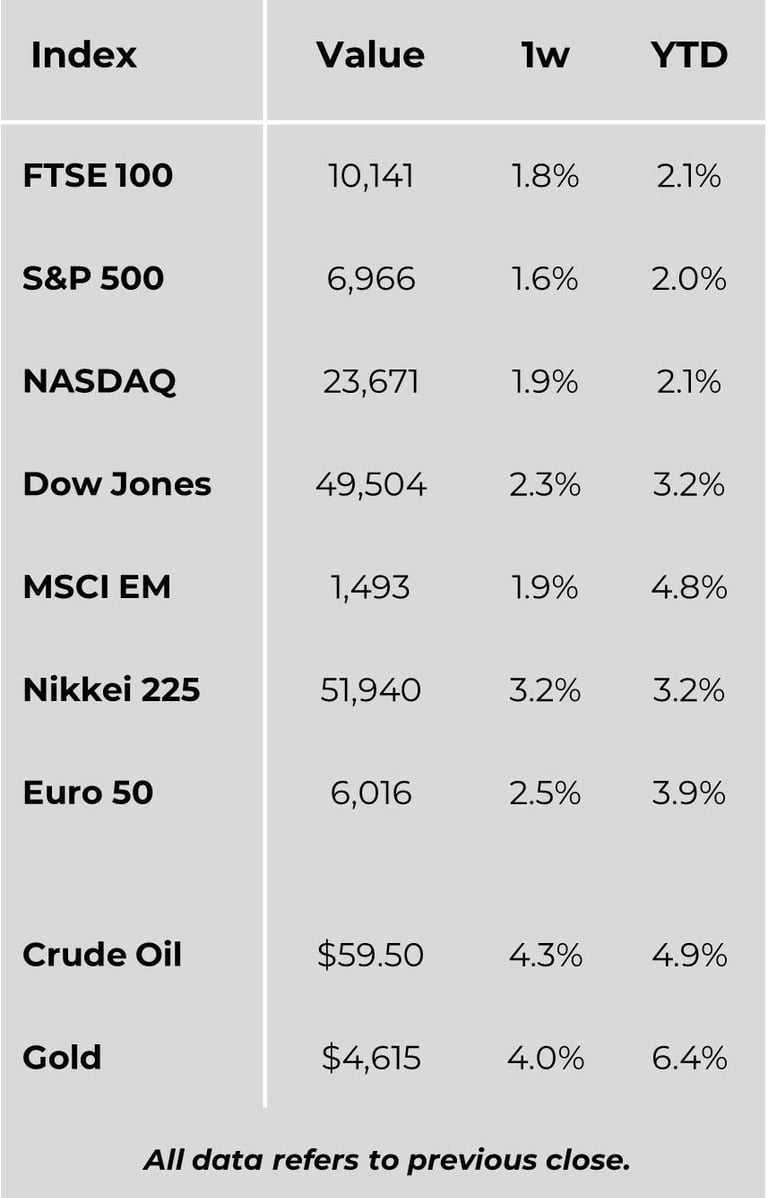
Markets Data

This publication is intended to be Hexagon Wealth’s own commentary on markets for clients. Hexagon Wealth Limited is authorised and regulated by the Financial Conduct Authority. FCA number 483403. Hexagon Wealth Limited is registered in England and Wales under company number 04503414. Whilst Hexagon Wealth uses reasonable efforts to obtain information from sources which it believes to be reliable, it makes no representation that the information or opinions contained in this document are accurate, reliable or complete and will not be liable for any errors, nor for any actions taken in reliance thereon. Such information and opinions are subject to change without notice. We expect readers to rely on their personal views on the subject when reading the opinions expressed above and contact their financial adviser before taking any action. It is not investment research and should not be construed as an offer or solicitation to buy, sell or trade in any of the investments, sectors or asset classes mentioned. The value of any investment and the income arising from it is not guaranteed and can fall as well as rise, so that you may not get back the amount you originally invested. Past performance is not a reliable indicator of future results. Movements in exchange rates can have an adverse effect on the value, price or income of any non-sterling denominated investment. Nothing in this document constitutes advice to undertake a transaction, and if you require professional advice please contact your financial adviser.